Archive / Portfolio, 2025–26
A portfolio that answered back.
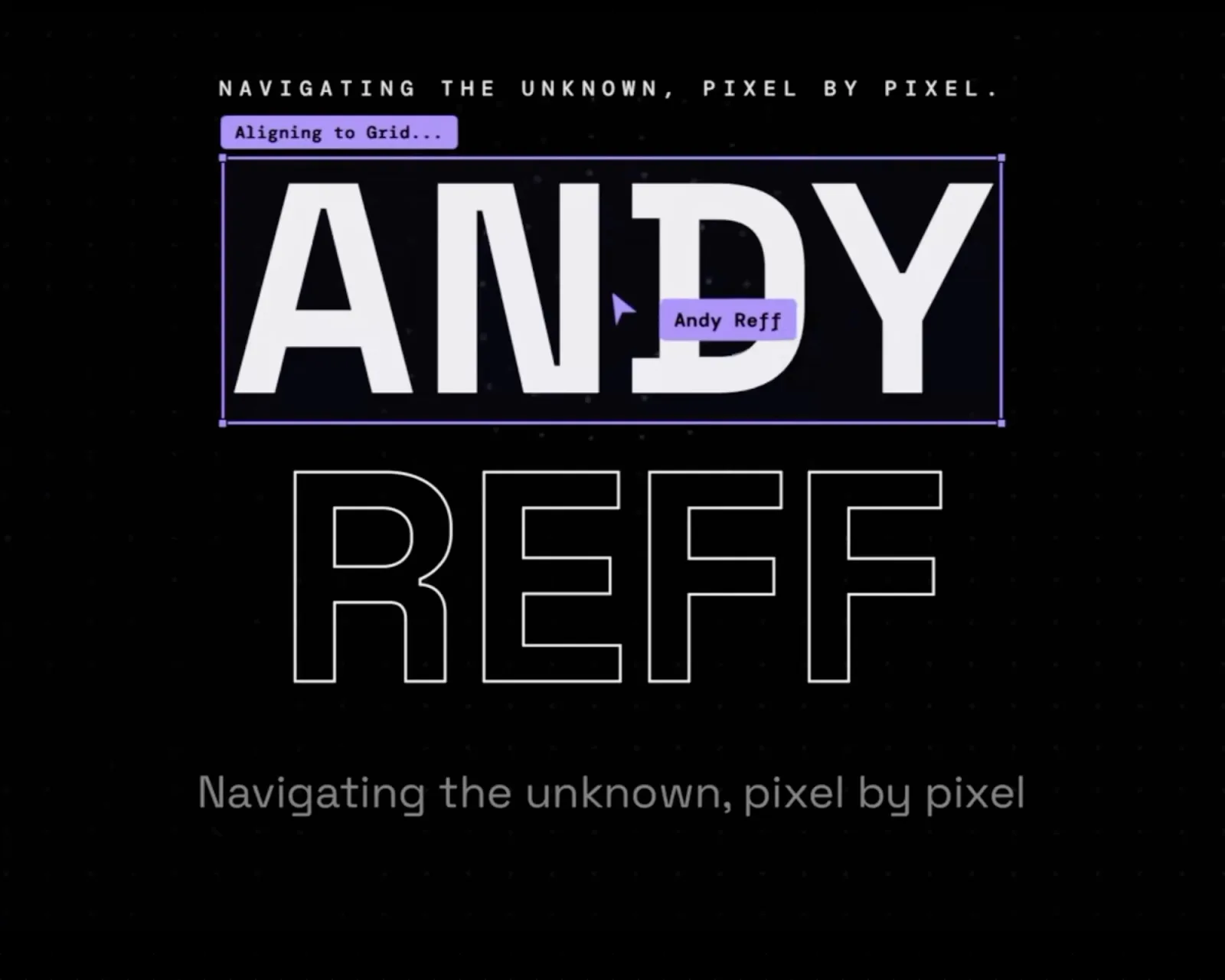
I wanted a portfolio that behaves like the work it shows: a living interface you can ask questions of, not a gallery of screenshots.
- My role
- Designer & Developer
- In collaboration
- Solo
- Timeframe
- 2025 – 2026
One decision: a site you can ask.
A portfolio is a document.
Everyone reads it the same way: scan the grid, open a case study, leave. Nothing about the format shows how a designer thinks in the moment.
Make it answer back.
I gave the site a voice and a second cursor. Ask it anything, by text or out loud, and watch it annotate its own pages as you move.
Let the craft be the proof.
Every interaction was built by hand: the particle grid, the perspective scroll, the card deck, the voice. The site became its own case study.
Connected moments
- Arrive
- Explore
- Ask
- Listen
- Remember
A minute is all a portfolio gets.
The assumption behind that site: recruiters and hiring managers give a portfolio about a minute. A static case study makes them read; nothing lets them ask. The portfolio before it showed none of the three things I most wanted a hiring team to see: product thinking, motion craft and AI experience design.
This is the story of the previous site, 2025 to 2026: the one that earned an Awwwards Honorable Mention (March 2026) and GSAP Site of the Day. You are looking at its successor, so the second cursor and the draggable headline described here are not on this page.
Designed and built end to end.
I designed and built the site end to end in React, GSAP and Three.js, with content in Sanity and a Claude-backed assistant trained on the portfolio. A site with a point of view: a second cursor called Andy that annotates the page, a hero you can drag, a dot grid that reacts to you, and a conversation by typing or by voice.
- The Andy cursor: a second pointer that comments on the page, Figma-style
- A canvas dot-grid hero with particle repulsion and a draggable headline
- A 3D perspective scroll transition and character-by-character text reveals
- The AI assistant: Claude answering as me, with an ElevenLabs voice, trained on the case studies
- A first-party analytics dashboard to read what visitors actually ask
- Shipped solo: design, front end, CMS and the serverless AI proxy
More of the work
A site that answers back.
Before
A conventional portfolio: a hero, a grid of projects, an about page. Competent, quiet, and indistinguishable from a hundred others. Nothing moved, and nothing answered.
After
A site people talk about. Visitors ask the assistant about the work in their own words and watch the page annotate itself. Awwwards gave it an Honorable Mention in March 2026, and GSAP named it Site of the Day.
It started conversations.
It did what a portfolio is for: it started conversations. The assistant’s logs showed exactly what recruiters wanted to know, which shaped the case studies that followed, and this site.
Recognition
- Awwwards · March 2026
- Honorable Mention
- GSAP Showcase · April 2026
- Site of the Day
- Designer, developer, and writer
- 1
The same convictions, on one screen.
This site is the next iteration: the same convictions, on one screen. Every case, principle and chapter is a wall of words, the work plays on old screens, and the assistant stayed. The previous site lives on as the case study you are reading.