All projectsLowe's / Mylow
Ask first. Shop second.
Make getting help with a home project feel less like searching a catalog and more like asking someone who knows.
Before you readMylow launched in March 2025. I joined the work the following month and have been on it since, shaping the experience as customers meet it now: the starting points, the follow-up questions, and how products enter the answer.
One decision:
ask before you answer.
Start with the problem, not the prompt.
A blank chat box is intimidating. Starting points shaped like real home improvement needs show what Mylow can do, so nobody has to learn how to talk to an AI before they get help.
Ask before you answer.
The right advice depends on the project, the home and the person. Short follow-up questions gather that context one step at a time, and each one makes the next response more relevant.
End with something to do.
Advice alone isn’t enough. Products appear inside the guidance, with the reason they fit, so the conversation ends in a next step and not in another search.
The customer was doing the translating.
Home improvement is a knowledge problem before it is a shopping problem. People arrive with a photo of something broken, a symptom without a diagnosis, or a project they have never attempted. Ecommerce works once you know what you want. Most customers don’t yet, and the store’s language of categories and part names stands between them and the answer.
Deciding how an assistant should behave.
As a Lead Product Designer on Mylow, Lowe’s AI-powered home improvement assistant, I worked with product and engineering to turn generative AI into something useful, understandable and recognisably Lowe’s. Much of the work wasn’t screens. It was deciding how an assistant should behave: when to ask, when to answer, when to show a product, and what to do when the customer changes direction.
- Starting points shaped like real needs (plan a project, find a product, troubleshoot, decide between options), so nobody faces a blank chat box
- Progressive conversations: light follow-up questions that gather context one step at a time, not a form up front
- Product discovery inside the conversation: recommendations arrive with the reason they fit
- A standard for a good response: scannable, actionable, in context, easy to continue
- A designed behaviour for each moment a conversation goes sideways: a vague question, several valid answers, a change of direction
From a search box to a conversation.
Every journey began with a search box, so the customer had to translate first. “My faucet is leaking” had to become a product name before Lowe’s could help. An experienced DIYer can do that. For someone on their first project, every step is a place to give up.
The starting point moved. A customer can say what they are trying to get done, and Mylow helps them understand the problem, asks a follow-up or two, finds the right products and shows what to do next. Before: “I need to figure out what I need so I can search for it.” After: “I can explain what I’m trying to do, and Lowe’s helps me figure out what I need.”
Expertise, at the moment of doubt.
Lowe’s has always been known for home improvement expertise. Mylow puts that expertise into the digital experience at the moment a customer is unsure. The value is designed to follow the customer: less uncertainty, more confidence in what they choose, and a shorter path from question to action.
What shipped
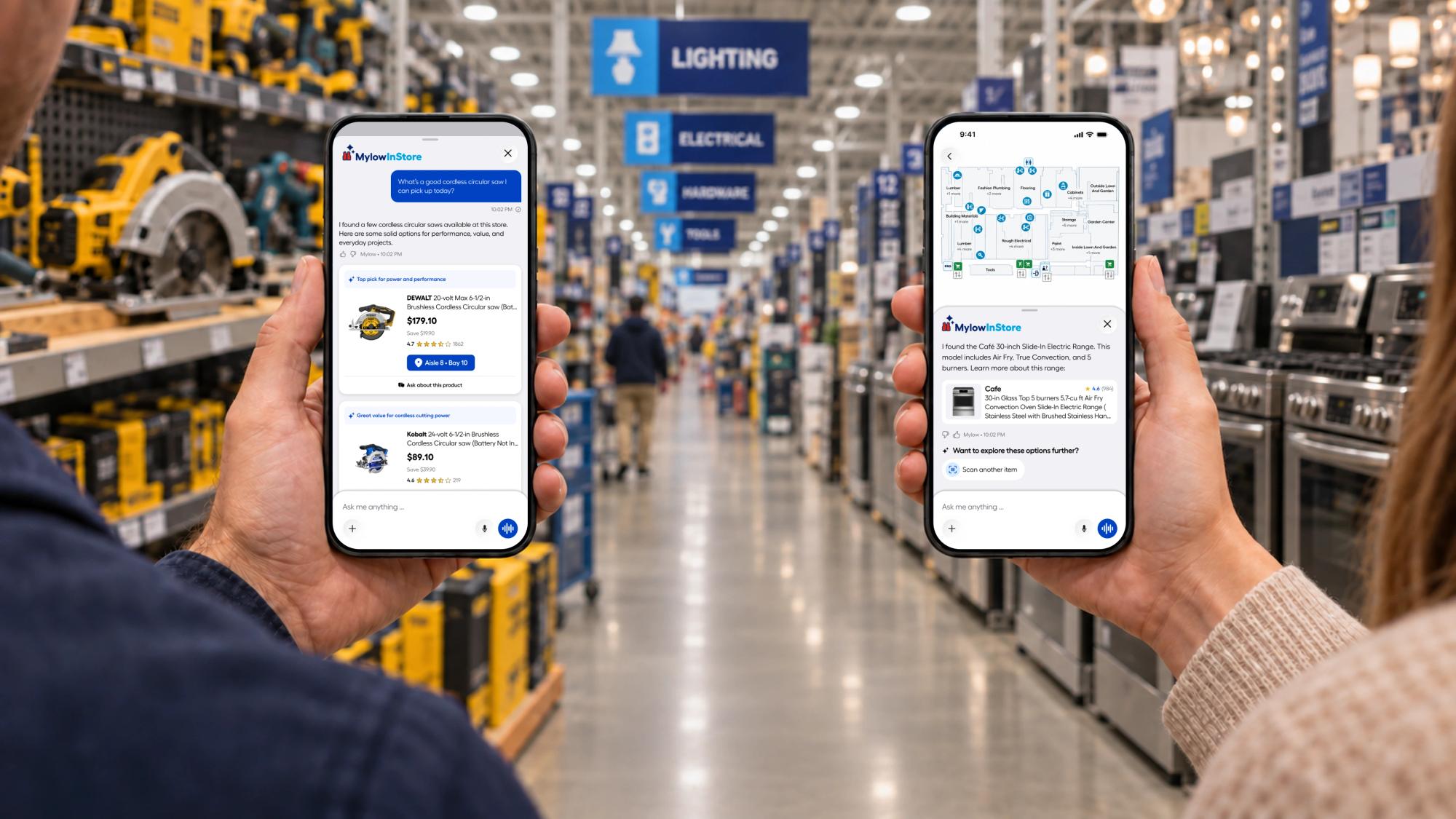
Mylow, Lowe’s AI home improvement assistant, on the product pages and in the store. The approach above lists the patterns.
What the experience does
Starts from what the customer is trying to do, not a search term; brings products into the answer with the reason they fit; leaves a next step on the screen. These are capabilities, not measured effects.
What I can’t say
Whether it worked in numbers. I work at Lowe’s, and Mylow’s figures are confidential; this case describes what the design is meant to change.
Assistance that disappears into the experience.
Where this goes is not a bigger chatbot, but assistance wherever understanding a customer’s intent makes the experience more helpful. Home improvement isn’t naturally text, either: often the easiest way to explain a problem is to show it. What I took from the work: customers should never have to become prompt engineers, and AI is at its best when it disappears into the experience.
The principle I carry forward
Nobody should have to learn how to talk to an AI before it helps them.